
Old Chapel and Burwell Cemetery
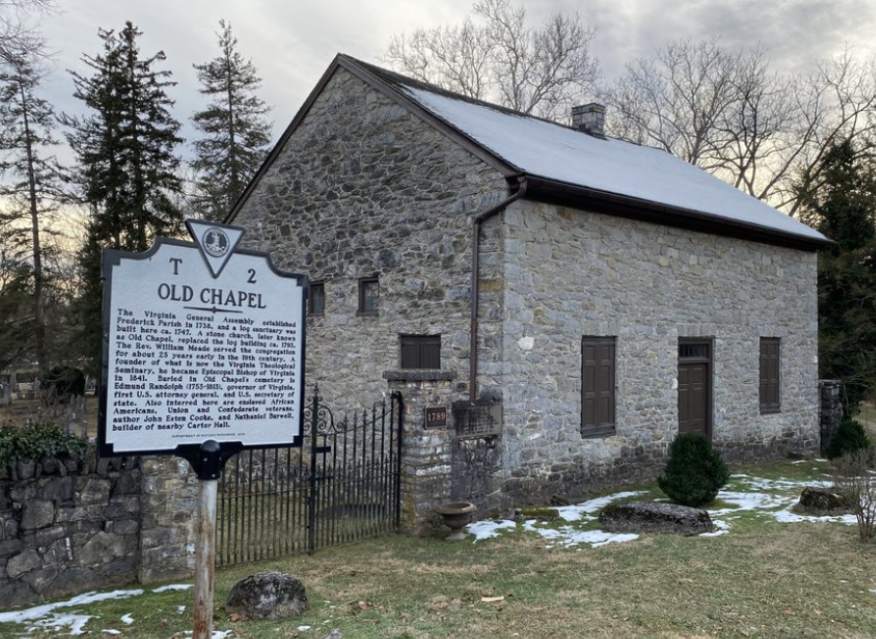
Old Chapel and Burwell Cemetery
3605 Bishop Meade Road
Millwood, VA 22620
Located at the intersection of Bishop Meade Road (VA 255) and Lord Fairfax Highway (US 340)
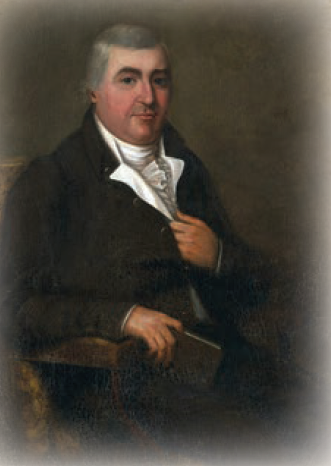
Colonel Nathaniel Burwell
The Old Chapel, located near Millwood in Clarke County, Virginia, is the oldest Episcopal church building still in use west of the Blue Ridge Mountains. The elegant limestone chapel was erected in the 1790s on the site of an earlier, 1740s-era log church called Cunningham's Chapel, named for its proximity to the nearby Cunningham Tavern. The original log chapel was renovated in 1762 but burned to the ground during the Revolutionary War.
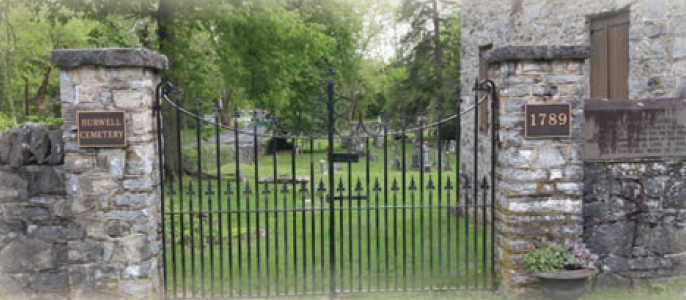
Burwell Cemetery
The Old Chapel and the adjacent Burwell Cemetery were established on land donated in 1789 by Colonel Nathaniel Burwell of Carter Hall, to be used in perpetuity as a place of worship and burial ground. Edmund Randolph, the first Attorney General of the United States, is buried in Burwell Cemetery along with members of other local families with Tidewater roots. Having outgrown the Cunningham Chapel structure in 1834, the congregation moved to the newly constructed Christ Church in Millwood, and the historic building was renamed “the Old Chapel.” In 1853, the parish vestry voted to hold at least two services per year at the Old Chapel—one in the spring and one in the fall. The chapel is still used today for an Easter morning sunrise service and an annual homecoming service held on the second Sunday in September.
Col. Nathaniel Burwell of Carter Hall
“Nat” Burwell was born on April 15, 1750, at the Carter’s Grove plantation, the son of Carter Burwell and Lucy Grymes Burwell. A precocious student, he matriculated at the College of William & Mary and received the institution's Botetourt Medal for scholarship upon graduation. When he came of age in 1771, he inherited extensive land in James City County from his great-grandfather Robert “King” Carter, including Carter’s Grove and 5,500 acres in the lower Shenandoah Valley.
In 1772, Nathaniel Burwell married his cousin Susannah “Sukie” Grymes, who gave birth to seven sons and one daughter before her untimely death in 1788. Colonel Burwell was deeply involved in Tidewater politics and represented James City County at the 1788 Virginia Convention, which was called to consider the ratification of the proposed United States Constitution. His pro-ratification stance at the Richmond Convention provided a major boost to James Madison in securing ratification—over the objections of Patrick Henry and George Mason—by a narrow 80–72 margin. Because his first wife had died within months of the convention, Burwell married Lucy Page Baylor, the widow of Col. George Baylor, in January 1789. Col. Burwell then moved with his new wife to the Shenandoah Valley to take control of his landholdings. In the 1790s, he built Carter Hall, named after his great-grandfather, and started a second family with Lucy, which consisted of five sons and three daughters. While he had a passion for breeding fine horses, Burwell was also a shrewd businessman; he established a ferry across the Shenandoah River and operated two grist mills, two distilleries, a sawmill, and a tannery. Nathaniel Burwell died at Carter Hall on March 29, 1814, and is buried in the Burwell Cemetery next to his beloved Lucy.
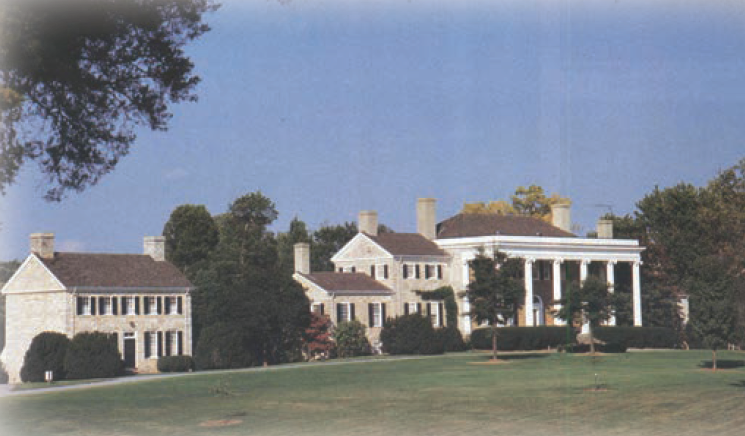
Carter Hall
Bishop William Meade
The Old Chapel is the church where William Meade, the third Bishop of Virginia, began his ministry in 1814. Born in Clarke County and educated at Princeton, he was a founder of the Virginia Theological Seminary in Alexandria. A “low churchman” with missionary fervor, he had a hand in founding most of the Episcopal churches west of the Blue Ridge Mountains. He wanted dearly to be buried in the Burwell Cemetery, but the demands of Civil War-era Virginia prevented the transfer of his body. After the war, he was reinterred at the Virginia Theological Seminary.
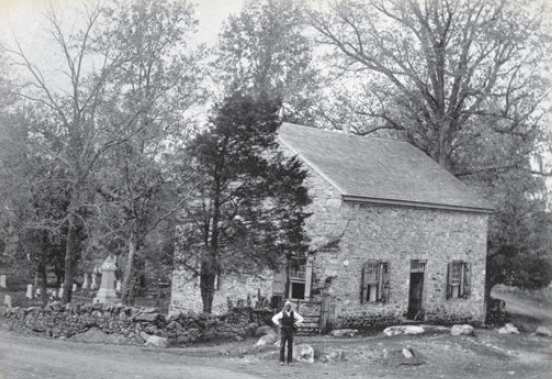
Old Chapel
During your visit to the Old Chapel, be sure to notice Bishop Meade’s elevated pulpit, from which he launched his thunderous sermons; the plaque documenting his dying wish to be buried nearby; and various memorial plaques to other chapel preservationists. Be sure to note the brass plates on the pews identifying the homes of the families who sat there during worship—such as Chapel Hill, Carter Hall, and Saratoga—as well as the balcony where enslaved drivers and servants sat during services.
Our Historic Preservation Efforts
We hope that you will enjoy your visit. The Burwell Cemetery and Old Chapel are managed and preserved by The Burwell Cemetery, Inc., a 501(c)(3) corporation whose mission embraces preservation, maintenance, and repair of the Old Chapel and Cemetery. The Burwell Cemetery has recently embarked upon a project to identify the final resting places of the enslaved who were buried near the families who owned them along the western wall of the cemetery enclosure. Their graves were initially marked with wooden crosses which have not withstood the ravages of time. With the aid of LIDAR Geophysical surveys, we have identified and marked the sites of 187 burials with positive identification of twelve persons. In the near future we intend to memorialize those so interred, known, and unknown.
We invite you to join us in achieving these worthy goals and ensuring the preservation of these historic landmarks
Checks should be made payable to “The Burwell Cemetery”, and mailed to:
The Treasurer
Burwell Cemetery
P.O. BOX 814
Berryville, VA 22611
For more information, contact Robert C. Randolph at 202-549-4904 or by email at rcrandolph@outlook.com.